
MALE ANATOMY
Puberty
People assigned male at birth start puberty later than people assigned female at birth. Changes largely revolve around the structure of the body as well as changes to the penis.
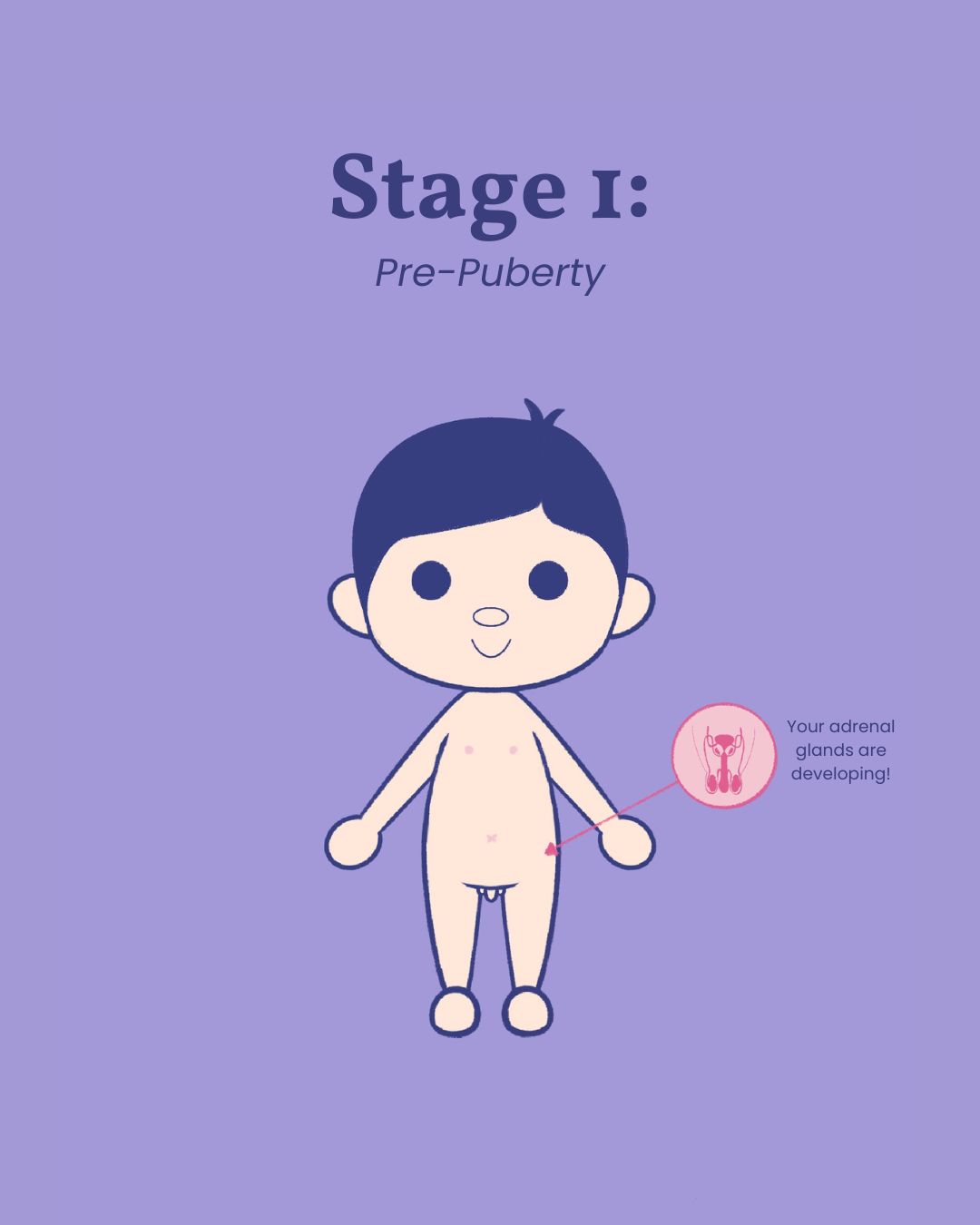
Prepuberty
Below Age 9
During the prepuberty stage, your body is still getting ready. Your adrenal glands (which produce a variety of hormones) are maturing. You won’t see any big changes on the outside yet, but you will soon!
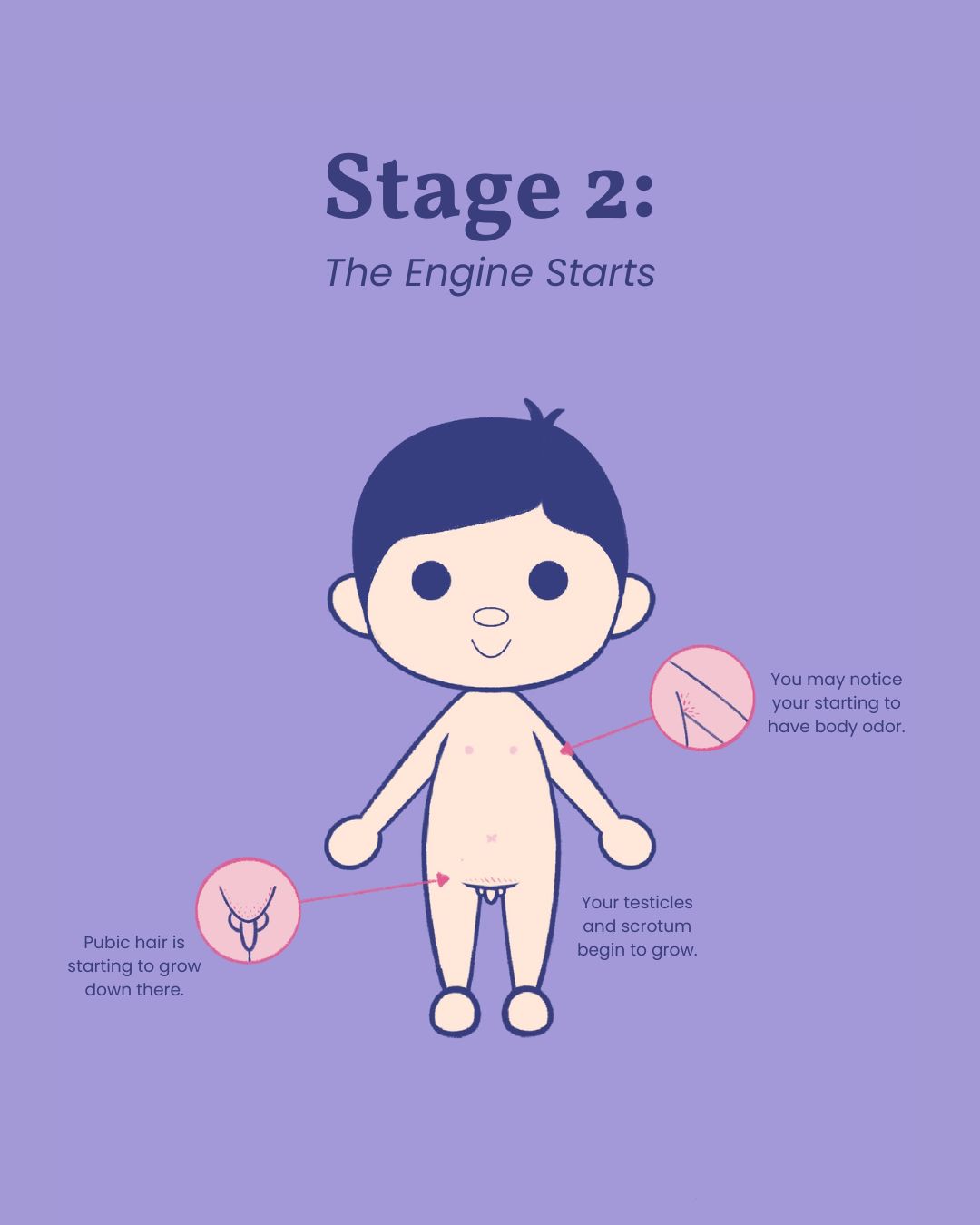
The Engines Start
Ages 9-14
This is where you see the first signs that things are changing.
Private Parts: Your testicles (balls) and scrotum (the sack that holds them) begin to grow.
Body Hair: A few fine, straight hairs appear at the base of your penis.
Growth Spurt: You start getting taller faster, about 2 to 2.5 inches a year. This can sometimes cause “growing pains” in your legs.
Body Stuff: You might start needing deodorant because of body odor. Your body also starts to build more muscle and have less “baby fat.
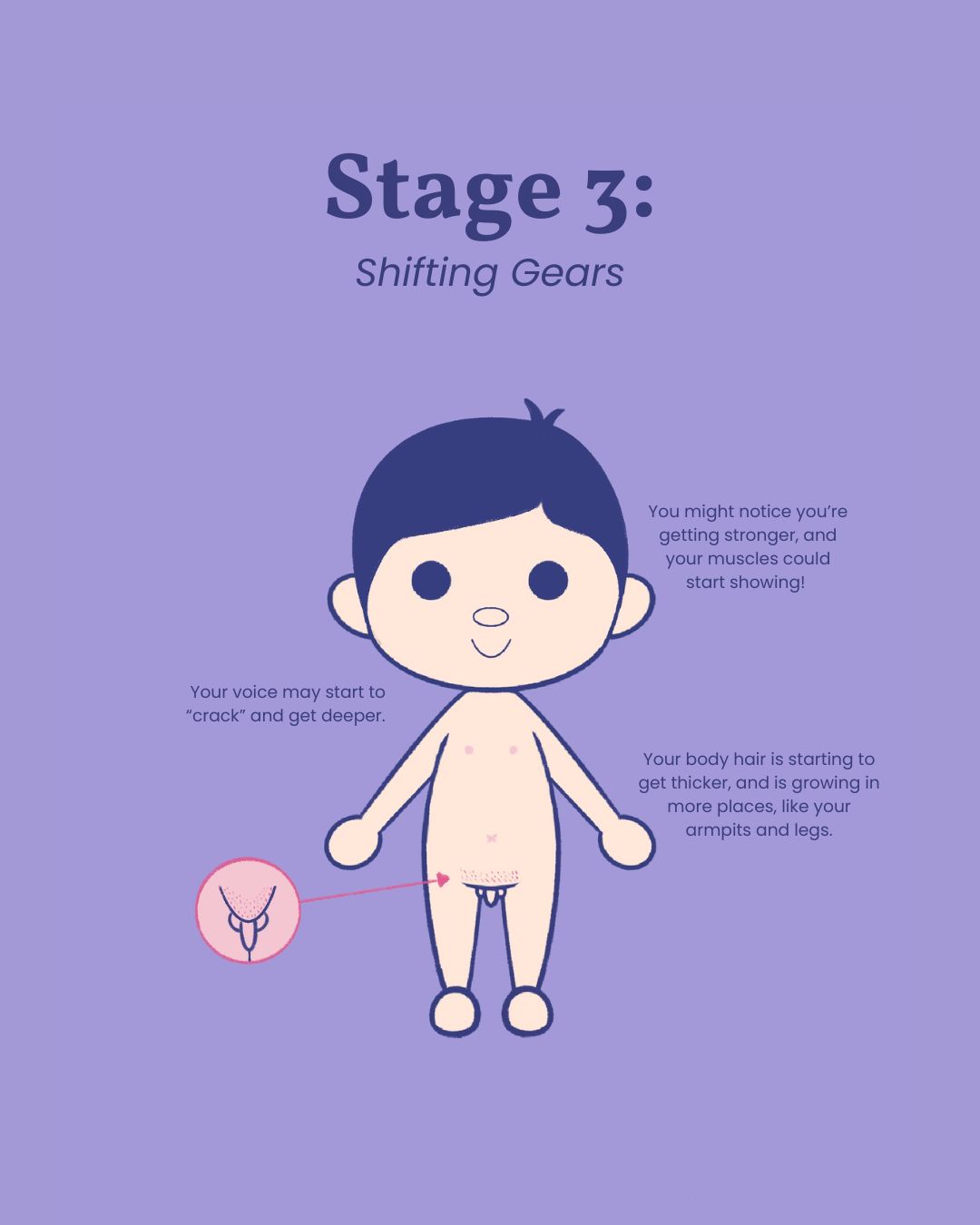
Shifting Gears
Ages 10-15
The changes from Stage 2 become more obvious, and new ones kick in.
Private Parts: Your penis continues to grow. You might experience your first “wet dream”. This is totally normal!
Body Hair: Pubic hair becomes darker, coarser, and curlier.
Growth Spurt: You’re growing about 3 to 3.5 inches a year.
Voice: Your voice may start to “crack” and get deeper.
Muscle: You’ll notice you’re getting stronger and more muscular. You may get a small, sometimes tender, lump under their nipples. This is called gynecomastia, and almost always goes away on its own.
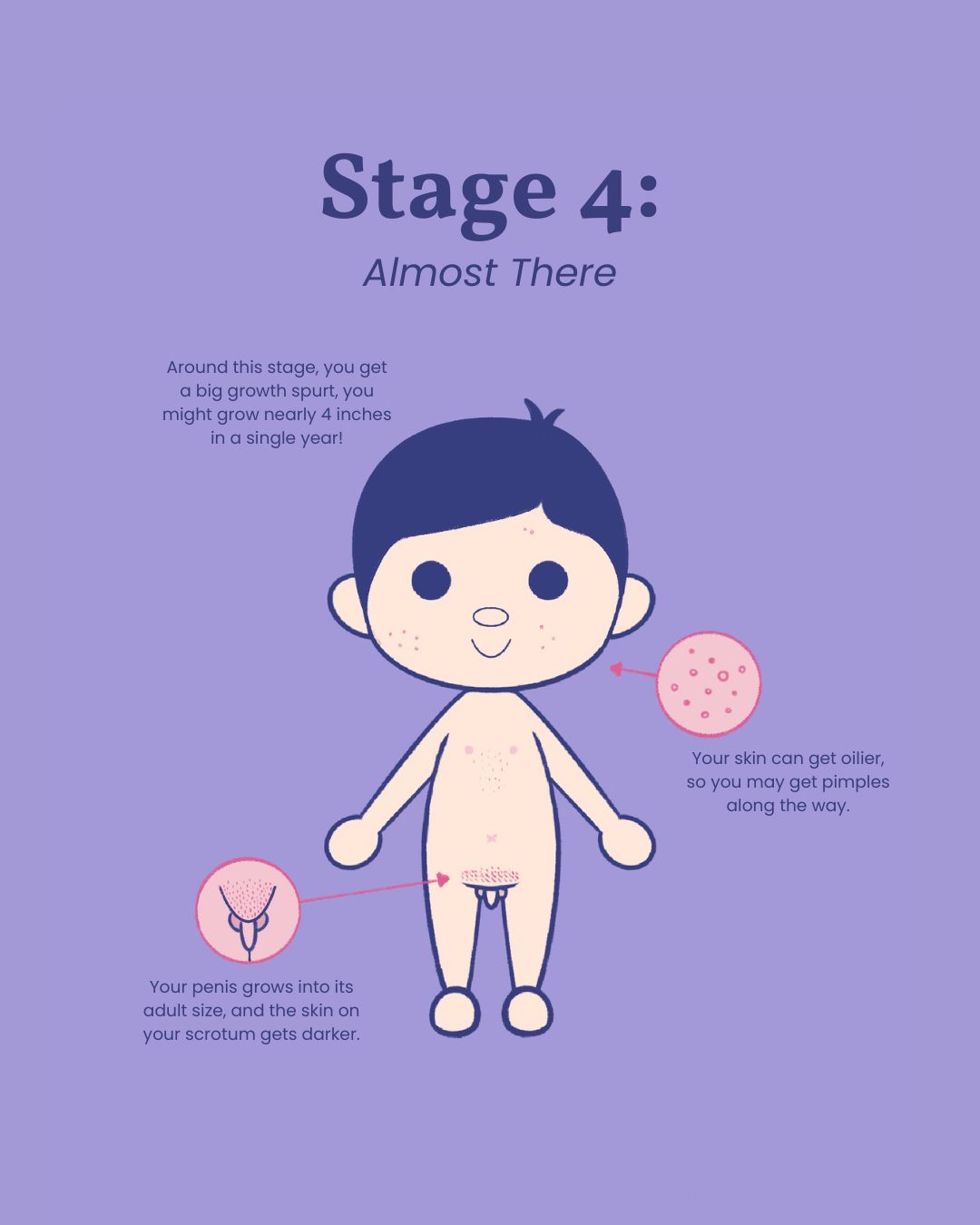
Almost There
Ages 11-16
Private Parts: Your penis grows to its adult size, and the skin on your scrotum becomes darker.
Body Hair: Pubic hair thickens to an adult amount. Hair on your arms, legs, and chest may become more noticeable.
Big Growth Spurt: This is often your fastest period of growth, you might grow nearly 4 inches in a single year!
Voice: Your voice is still settling down and may continue to crack.
Skin: Acne is common as your skin gets oilier.
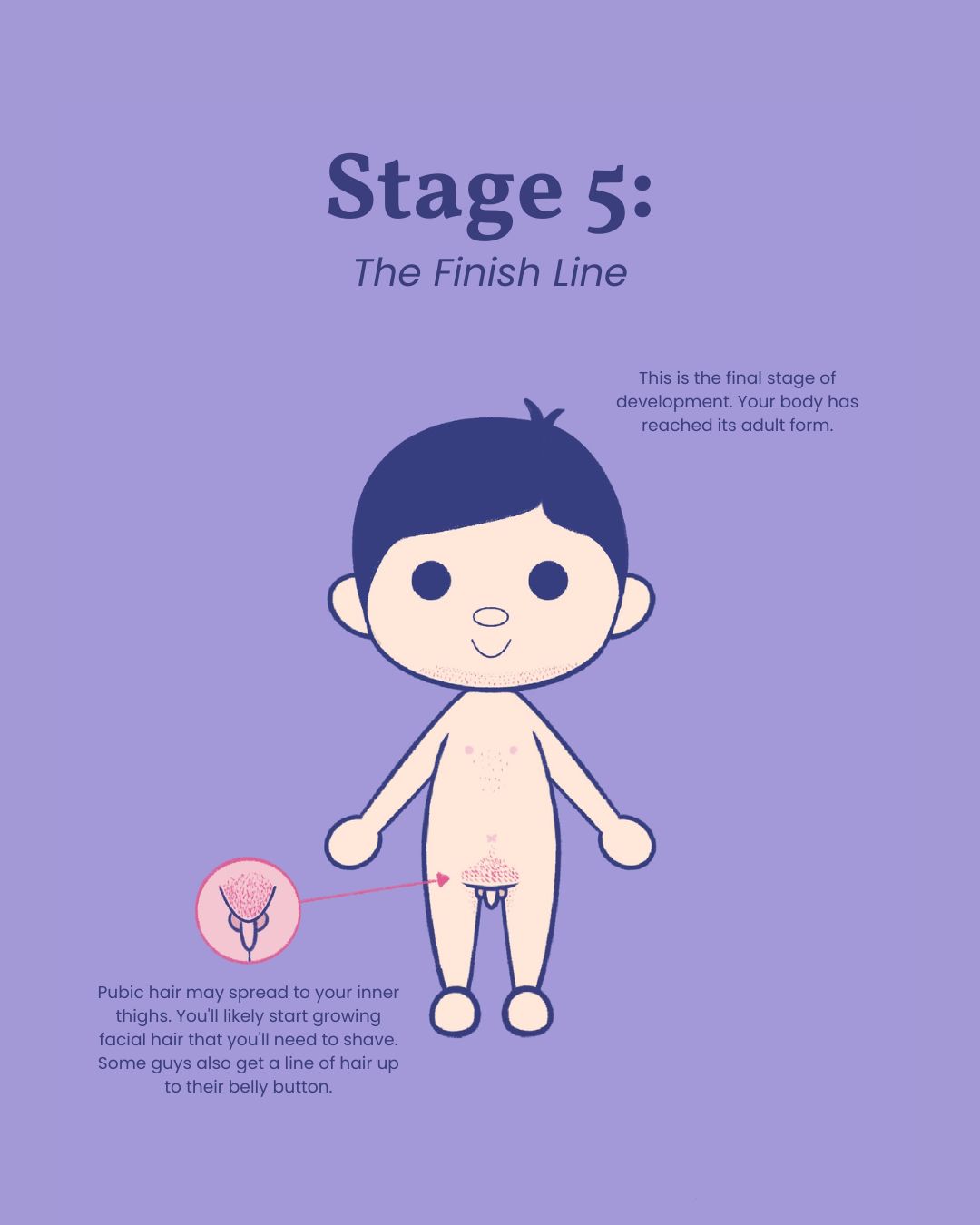
The Finish Line
Above Age 15
This is the final stage of development. Your body has reached its adult form.
Body Hair: Pubic hair may spread to your inner thighs. You’ll likely start growing facial hair that you’ll need to shave. Some guys also get a line of hair up to their belly button.
Height: Most guys stop growing taller by age 17, but it’s not unusual to keep growing a little into your early 20s.
Muscle: You can continue to build muscle mass into your early adulthood.
REMEMBER: This is a general guide. Your personal journey is unique to you. The most important thing is that you’re healthy and comfortable with the changes you’re experiencing. If you ever have questions or concerns, talking to a trusted adult, school nurse, or doctor is always a great idea.
Internal organs
Vas deferens – A long tube that travels from the epididymis into the pelvic cavity, just behind the bladder. It transports mature sperm to the urethra in preparation for ejaculation.
Ejaculatory ducts – These are short ducts formed where the vas deferens and the seminal vesicles meet. They collect fluids from the prostate to make semen and then empty everything into the urethra.
Urethra – The urethra is the tube that carries pee and semen out of the body. When your penis is erect, your corpora cavernosa presses against the part of the urethra where pee flows, blocking it so that only semen comes out during orgasm.
Seminal vesicles – These are two small sacs that produce a sugary fluid which makes up most of the semen’s volume. This fluid gives sperm the energy they need to swim.
Prostate gland – This is a walnut-sized gland that adds more fluid to the semen, which helps nourish and protect the sperm.
Bulbourethral (Cowper) glands – These are two tiny glands that produce a clear, slippery fluid. This fluid is released before ejaculation to clean and lubricate the urethra, making it a safer path for the sperm.
External organs
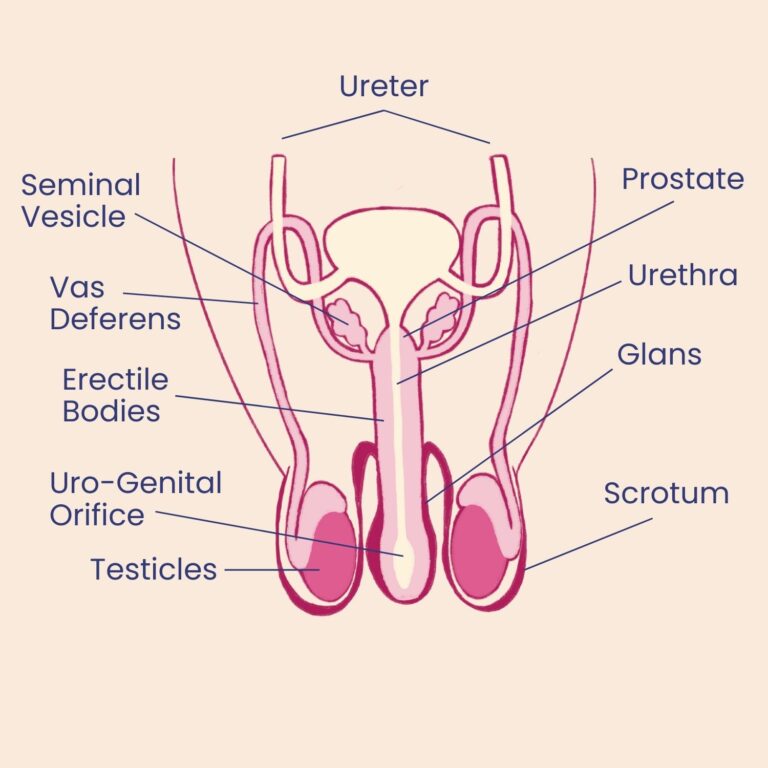
Penis – The male organ for sexual intercourse. It contains many sensitive nerve endings.
Root – The base of the penis, which attaches it to the wall of the abdomen.
Body (shaft) – Consists of three internal chambers: two corpora cavernosa, and the corpus spongiosum. During sexual arousal, the spaces fill with blood, and the penis may form an erection.
Glans (head) – The cone-shaped tip of the penis. A loose layer of skin covers the glans, called the foreskin, which can be surgically removed through the process of circumcision.
Scrotum – The loose, pouch-like sac of skin that hangs behind the penis. It holds the testicles, as well as nerves and blood vessels.
Testicles – Oval-shaped organs that lie in the scrotum which make testosterone and produce sperm.
Epididymis – A long, coiled tube that rests on the back of each testicle. It carries and stores the sperm cells that the testicles create and bring them to maturity.
Circumcision
Circumcision is a minor surgery where the sleeve of skin (called the foreskin) covering the end of a penis is removed. This leaves the tip of the penis exposed.
For a baby, a circumcision is usually done within their first 10 days. They’re done either in the hospital by the pediatrician, family doctor, or obstetrician, or, for some religious ritual circumcisions, at home. Premature babies or babies with complications may need more time before they can be circumcised.
Families might choose it for religious reasons (like in Judaism and Islam), cultural traditions, or for personal preferences about health and appearance. Others choose not to.
Benefits
Going through circumcision lower the chances of:
- Infections: It’s easier to keep clean, so there’s less risk of infections under the skin.
- UTIs: It lowers the risk of urinary tract infections, especially for babies.
- STDs: Studies show it can lower the risk of getting some sexually transmitted diseases, like HIV, when a person is older.
- Penile Cancer: It lowers the risk of a very rare type of cancer called penile cancer.
Risks
Like any surgery, circumcision has some risks:
- Bleeding or Infection: There can be a little bleeding or a minor infection.
- Healing Issues: Sometimes, too much or too little skin is removed, or scar tissue can form.
Care Tips
No special products are needed for cleaning either. Warm water is all that’s needed.
After a circumcision, it is important to keep the area as clean as possible. It usually takes between 7 to 10 days for a circumcised penis to heal. Initially the tip may appear slightly swollen and red, and you may notice a small amount of blood on the diaper or underwear used. You also may notice a slight yellow discharge or crust after a couple of days. This is part of the normal healing process.
Initially, do not pull back the foreskin to clean beneath it. Over time, the foreskin will retract on its own so that it can be pulled away easily from the glans toward the belly. This happens at different times for different boys, but most can retract the foreskin by the time they reach puberty. To wash beneath the foreskin, gently pull it back from the glans, rinsing the glans and the inside of the foreskin with warm water, then pulling the foreskin back over the head of his penis.
References
https://my.clevelandclinic.org/health/body/9117-male-reproductive-system
https://kidshealth.org/en/parents/circumcision.html
https://my.clevelandclinic.org/health/body/puberty
https://my.clevelandclinic.org/health/symptoms/16227-enlarged-male-breast-tissue-gynecomastia